Salt Air and Smooth Wheels: Your Honest Guide to Riding the British Seaside

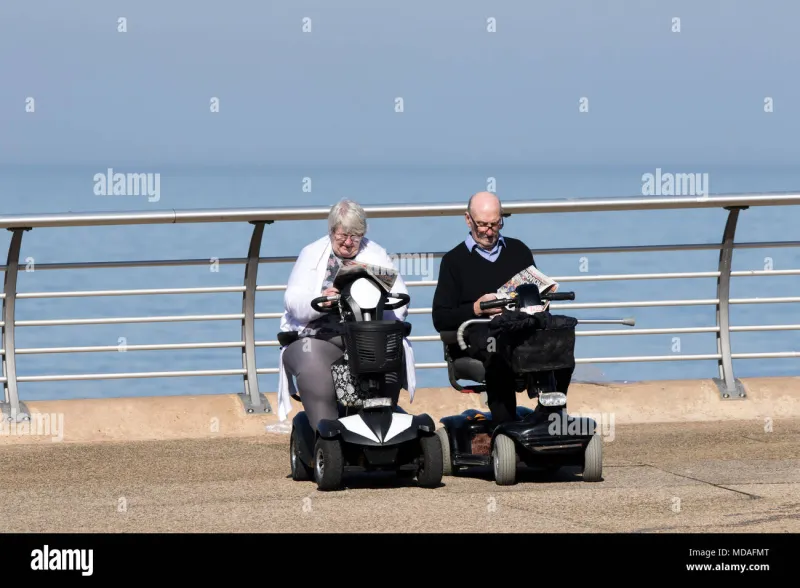
Photo: Gordon Leggett, CC BY-SA 4.0, via Wikimedia Commons
There's something about the seaside that lifts the spirits — the smell of fish and chips, the cry of gulls, the endless view out to sea. And for those of us on four wheels, a good promenade can be one of the finest rides in Britain: flat, wide, and made for a slow, scenic potter.
But not every coastal town is quite so obliging. Some welcome scooters with open arms and miles of smooth paving; others have narrow Victorian boardwalks, steep slipways, or councils with firm views about where wheels belong. Here's our honest, region-by-region rundown, plus a few tips for making your first seaside trip a happy one.
The Big and Breezy: Resorts Built for Riding
Let's start with the good news. Britain's larger seaside resorts generally have broad, modern promenades that are ideal for scooters.
Blackpool is the obvious headline act. The promenade runs for around eleven miles along the Fylde coast, and the newer sections — particularly the rebuilt central and south promenades — are wide, smooth and step-free. You can roll from South Shore right up towards Bispham with the Illuminations stretching ahead of you (a genuine treat in autumn, though wrap up warm). Summer Saturdays get busy, but there's plenty of room to pass.
Cleethorpes offers a lovely flat ride along its North Promenade, with accessible beach matting laid out in summer to get you closer to the sand. Weston-super-Mare similarly pairs a long, level seafront with beach access mats near the main entrances — worth checking the council's website before you travel, as matting is seasonal.
Skegness, Great Yarmouth and Southend-on-Sea all fall into the same camp: long, straight promenades with plenty of width, ramped access points and the sort of hard surface that treats suspension kindly.
The Pretty but Tricky: Victorian Resorts
Smaller, older resorts are where things get complicated. Many of Britain's most charming coastal towns grew up in the Victorian era, long before anyone thought about wheelchair or scooter access — and it shows.
Cromer and Sheringham in North Norfolk have promenades that are accessible in places, but expect steeper clifftop approaches and some narrower sections. Llandudno is a strong performer — its wide promenade and flat seafront road suit scooters well, though the famous pier gets tight on busy days. Eastbourne and Bognor Regis are surprisingly good, with level promenades and plenty of benches for a breather.
Where you're more likely to hit problems: tiny harbourside towns like Polperro or Clovelly (the latter explicitly prohibits wheeled transport down its cobbled main street — no exceptions, and they mean it), steep-quayed Brixham side lanes, and any boardwalk-style construction where decking planks can catch small wheels.
Know the Rules of the Road (and the Pavement)
The legal picture is simpler than many people fear. Class 2 mobility scooters — the pavement-only type, limited to 4mph — are permitted on most public promenades, since these are treated as pedestrian areas. Class 3 machines, which can travel at 8mph on roads, are equally at home on a promenade, and the extra speed is handy on long seafronts.
A few councils have local bylaws restricting wheeled vehicles on specific promenades or piers, usually for safety in crowds. Look for signage at access points, and if in doubt, the town's tourist information office or the council's website will settle the question. Private piers — and many are privately owned — set their own rules, so a quick phone call before you set off can save a turn-around at the turnstile.
Practical Tips for Your First Coastal Ride
A little preparation goes a long way:
- Check the tide times. Obvious, perhaps, but a high tide can cut off sections of promenade at some resorts and leave you doubling back.
- Mind the salt. Sea air is corrosive. Give your scooter a wipe-down after any coastal trip, paying attention to metal fittings and connections.
- Charge fully before you go. Promenades look flat but can have gentle gradients, and headwinds off the sea will eat battery faster than you'd expect. Plan for no more than 80% of your usual range.
- Beat the crowds. A midweek morning in June is a different experience to a bank holiday Saturday in August. Go early, when the promenade belongs to the gulls and the ice cream sellers.
- Pack a flask and a flask of patience. Seaside car parks can be heaving; accessible parking bays near promenade access points fill up quickly.
Is Your Scooter Seaside-Ready?
If coastal trips are on your agenda, it's worth being honest about whether your current machine suits the job. Pneumatic tyres cope far better with long, slightly cambered promenades than solid ones, and a comfortable, supportive seat makes a two-hour potter a pleasure rather than an endurance test. If your scooter is more of a compact boot-and-shops model, you might find longer seafront rides a strain — something to weigh up if the seaside features heavily in your plans.
The Bottom Line
The British seaside is, on the whole, remarkably scooter-friendly — the big resorts practically beg for it, and even the prettier Victorian towns are improving year on year. Do a little homework, time your visit well, and there's no reason your wheels can't enjoy the sea air as much as you do. Now, who's for a 99 with a Flake?